
Why Misaligned Funnels Feel Heavy to Maintain
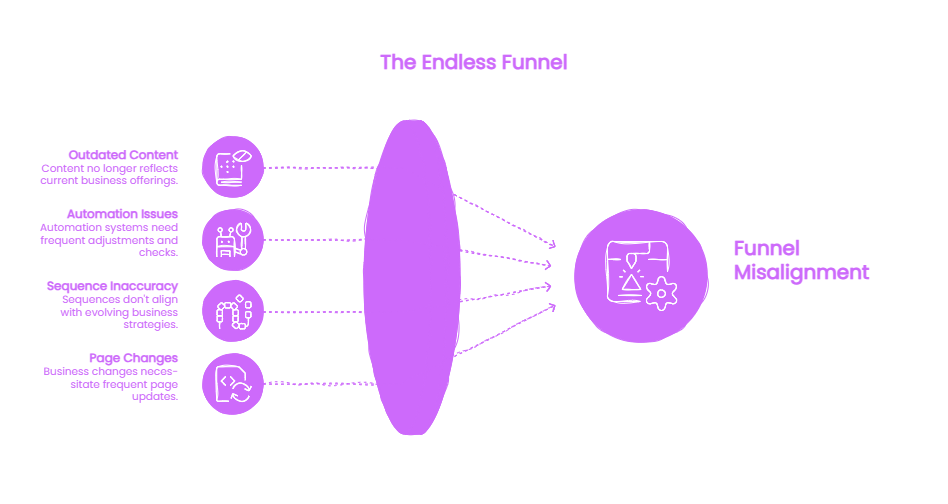
A funnel can be fully built and still feel like it is constantly asking for attention. Something needs to be updated, an automation needs to be checked, a sequence no longer reflects the offer, or a page needs to be changed because the business has changed again. The work can begin to feel endless, especially when the funnel was expected to create more ease after it was completed. Instead of becoming a reliable pathway the business can operate, it becomes another environment that has to be remembered, monitored, corrected, and manually supported. The business owner may begin to assume that this is simply what funnel ownership requires or that they are failing to maintain the system properly. But ongoing operational weight can contain information about the relationship between the funnel and the business it was built to serve. When a funnel consistently requires disproportionate effort to keep functioning, the question is not only what needs to be fixed inside the funnel but whether the funnel is carrying conditions the business has not yet resolved.
Maintenance Is Information
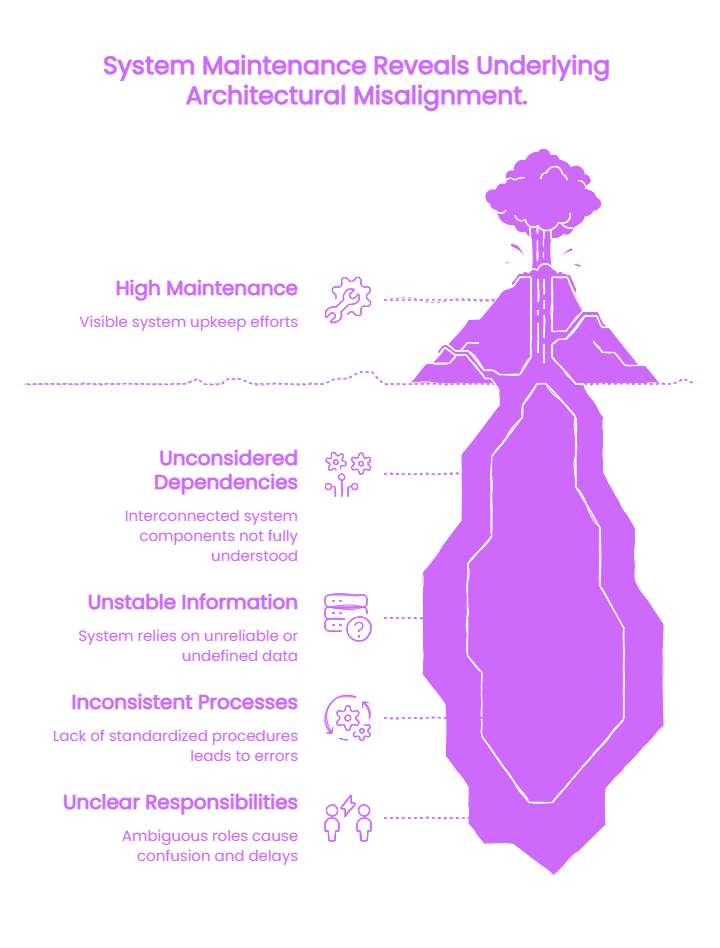
Every system requires some degree of maintenance because businesses change, offers evolve, technology updates, and customer behavior shifts over time. A funnel does not become permanently complete simply because the initial build has been finished, and healthy maintenance is part of responsible system ownership. The problem emerges when the level of maintenance consistently exceeds what the business can reasonably understand, support, or sustain. When every change to the offer creates changes across multiple pages, sequences, automations, tags, forms, and follow-up processes, the business may be experiencing more than ordinary maintenance. The operational heaviness may be revealing dependencies that were never fully considered when the funnel was designed. A business can mistake this experience for a discipline problem and repeatedly tell itself to become more consistent, more organized, or more attentive to the system. Sometimes greater discipline is useful, but sometimes the system is accurately revealing that the architecture does not correspond to the way the business actually operates.
The feeling of difficulty should therefore be treated as information before it is treated as failure. If the same parts of a funnel repeatedly create confusion, require manual intervention, or break whenever something upstream changes, those patterns deserve examination. Repeated friction often reveals where the system depends on unstable information, undefined decisions, inconsistent processes, or responsibilities that have not been clearly established. The funnel may be functioning exactly according to the conditions it was given, even when those conditions no longer reflect the business. This is important because continually repairing the visible symptom without examining its source can create an endless cycle of maintenance. The business keeps adjusting the page, rewriting the sequence, reconnecting the automation, or changing the tool while the condition producing the problem remains in place. Maintenance becomes much more useful when the business learns to distinguish between normal system care and repeated compensation for misalignment.
What Misalignment Creates
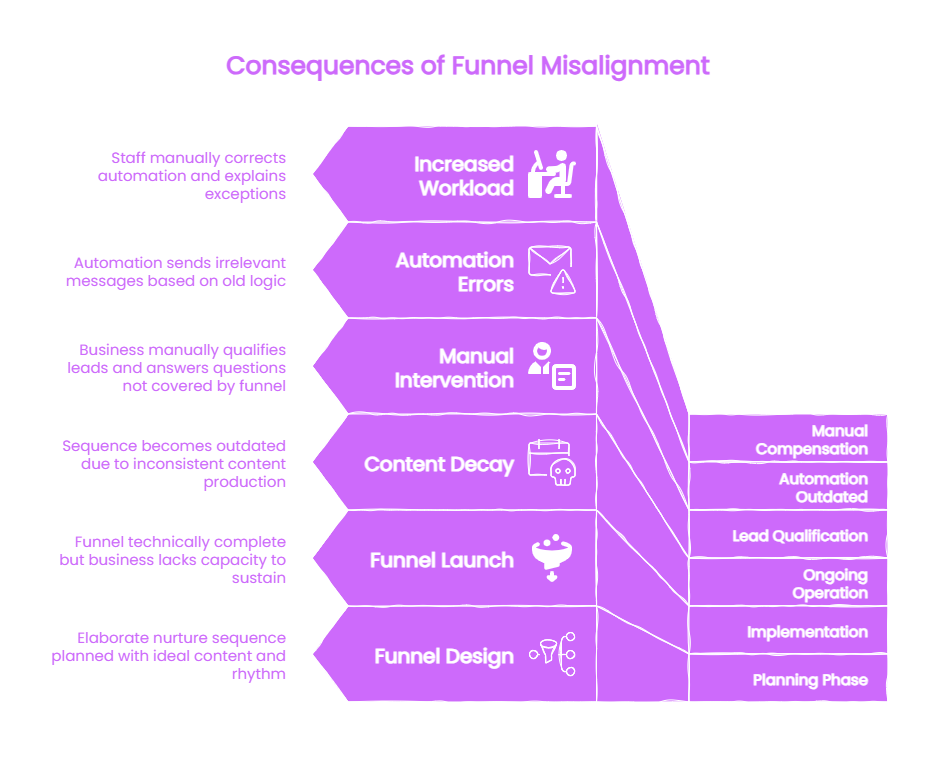
A funnel can feel heavy when it requires a level of content production the business does not naturally or operationally sustain. An elaborate nurture sequence may depend on regular emails, educational content, events, offers, or updates that sounded appropriate during planning but do not fit the actual rhythm of the business. The funnel may technically contain everything it needs, yet the business behind it may not have the capacity, process, or content infrastructure required to keep those components current. Over time, the sequence becomes outdated because the business cannot consistently supply what the funnel assumes will be available. The problem may appear to be that the business owner is not using the funnel correctly, when the deeper issue is that the architecture requires an operating rhythm the business never established. A system becomes heavy when its ongoing requirements exceed the conditions available to carry them. In that situation, the appropriate response may involve examining the relationship between the funnel's demands and the business's actual capacity rather than simply adding another reminder to maintain it.
Misalignment can also create heaviness through the kind of leads and decisions the funnel produces. A funnel may generate interest, but the people entering may require conversations, qualification, education, or sales support that the business does not have a defined process for handling. The business then begins manually stepping into the gaps between the funnel and the actual conversion process. Someone has to determine what happens next, answer questions the funnel did not prepare for, decide whether a lead is qualified, or repeatedly explain information that should already have been appropriately placed within the journey. The funnel may be generating activity without governing the progression that follows the activity. This creates operational weight because people become responsible for supplying the decision logic the system does not contain. What appears to be a lead problem, or a follow up problem can therefore be a mismatch between what the funnel produces and what the business is actually prepared to receive.
Another form of heaviness appears when the automations inside a funnel no longer reflect the customer journey the business is actually creating. An automation can continue sending messages based on decisions, timelines, or behaviors that were relevant when the funnel was built but have since changed. The business then begins manually stopping sequences, correcting tags, moving people between stages, or explaining exceptions that the automation was never designed to recognize. These interventions are sometimes necessary because real businesses contain variation, but constant intervention can indicate that the automation is operating from outdated or incomplete logic. Automation does not independently understand the current state of the business or the intent behind a decision. It performs according to the conditions, triggers, and pathways that have been established for it. When those conditions are unclear or repeatedly changing, the automation exposes that instability through the work people must perform around it. The heavier the manual compensation becomes, the more important it is to examine whether the issue belongs inside the automation or in the business decisions the automation is attempting to execute.
The Difference Between Complexity and Misalignment
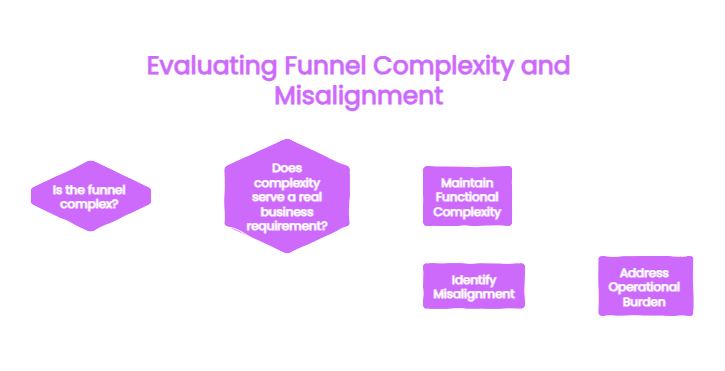
A complex funnel is not automatically a misaligned funnel. Some businesses legitimately require multiple pathways because they serve different audiences, offer different services, operate across several stages of readiness, or need distinct qualification and conversion processes. Those conditions can create genuine complexity because the business itself contains relationships that the system must account for. Removing necessary complexity simply to make a system look cleaner can create a different form of misalignment. The question is therefore not whether the funnel contains many components but whether those components correspond to a real requirement within the business. Complexity that serves an actual function can be designed, documented, supported, and maintained with appropriate responsibility. Complexity becomes problematic when components exist without a clear relationship to the movement the business actually needs to govern.
Misalignment creates a different experience because the work inside the funnel begins to feel disconnected from the business it is supposed to support. The business may maintain sequences that no longer serve the current offer, collect information that no one uses, send people through stages that do not affect the next decision, or operate multiple pathways that perform essentially the same function. Each individual component may appear reasonable when viewed separately, but together they create unnecessary operational responsibility. The business has to remember why everything exists because the architecture itself does not clearly communicate its purpose. This is where accumulation can become confused with sophistication. More pages, automations, tags, sequences, and pathways can create the appearance of a sophisticated system while increasing the amount of work required to keep unrelated components functioning together. A well aligned system can be complex, when necessary, but its complexity should remain connected to a defined reason for existing.
When the Funnel Is Carrying Work the Business Has Not Defined
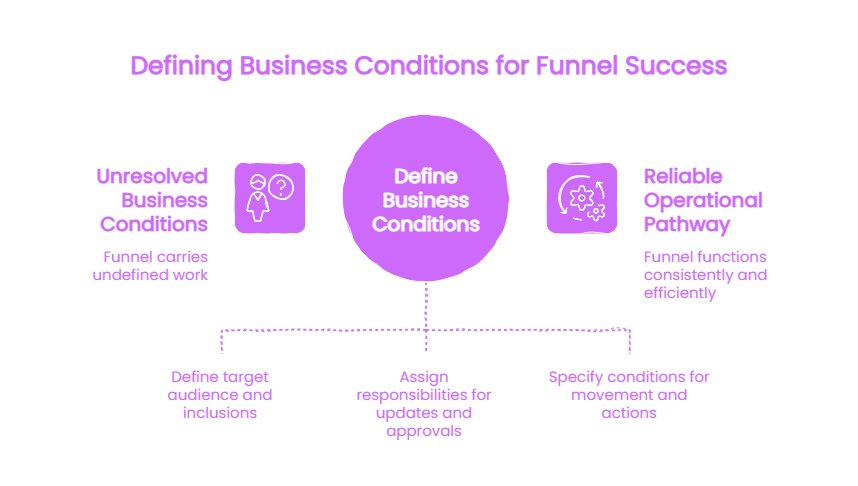
Funnels frequently become the place where unresolved business conditions become visible because execution eventually requires decisions to become concrete. A page cannot accurately communicate an offer that remains unclear, and an automation cannot consistently route people through a journey when the conditions for movement have not been defined. The business may still be deciding whom the offer is for, what is included, who owns a particular responsibility, or what should happen when a client reaches a specific stage. Those unresolved questions do not disappear when the funnel is built around them. Instead, they often reappear later as edits, exceptions, manual workarounds, conflicting instructions, and repeated requests to change the system. The funnel is then asked to remain flexible enough to carry indecision while also functioning as a reliable operational pathway. That is a significant burden for any system because systems require some degree of decision finality in order to perform consistently.
Undefined ownership can create the same kind of weight. If no one has established who is responsible for updating an offer, reviewing automation performance, approving messaging changes, supplying required content, or responding to leads at a particular point in the journey, the work does not disappear. It simply becomes reactive. Someone eventually notices a problem and attempts to correct it, often without knowing whether that correction affects another part of the funnel. The system begins depending on memory and individual intervention rather than established responsibility. Over time, maintenance feels heavier because the business is not only maintaining technology but also repeatedly reconstructing the decisions surrounding it. A funnel cannot govern ownership that the business itself has left undefined. When responsibility remains unclear upstream, the execution layer eventually inherits that uncertainty.
Trace the Source of the Weight
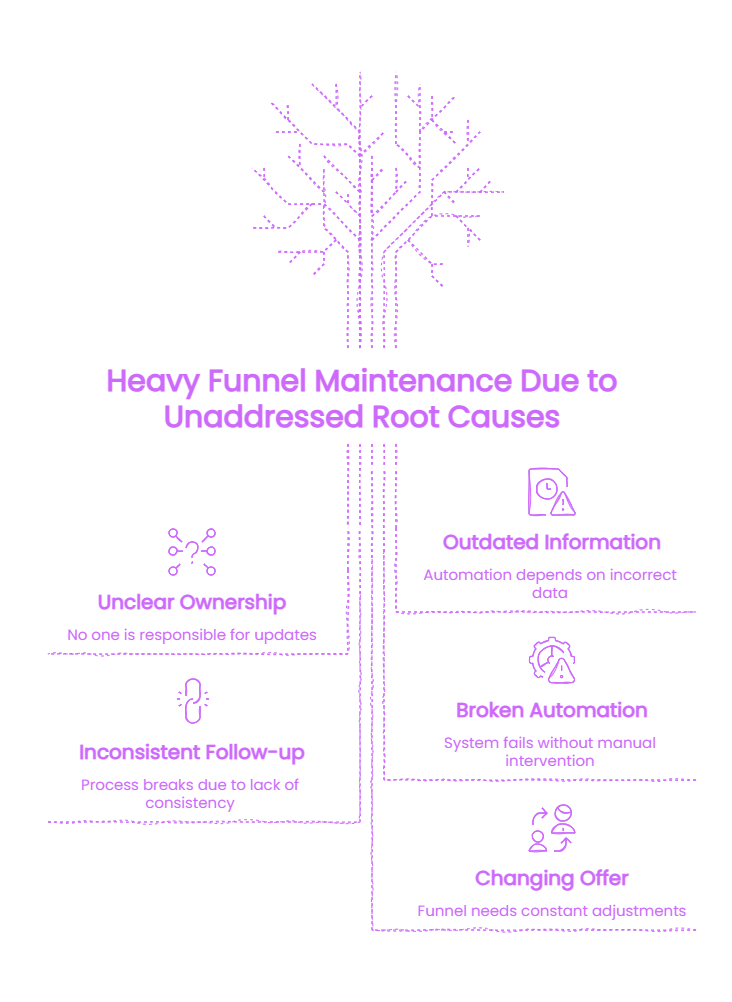
Choose the part of your funnel that currently feels most difficult to maintain and resist the immediate impulse to fix it. Begin by identifying exactly what makes that area heavy, whether the issue involves repeated edits, constant manual intervention, outdated information, unclear ownership, broken automation, inconsistent follow up, or another recurring condition. Then trace backward from the visible problem and ask what decision originally created the requirement for that component to exist. Consider what information the component depends upon, who is responsible for keeping that information current, and whether that responsibility has actually been established. Examine what the funnel or automation assumes to be true in order to function correctly. If those assumptions change repeatedly or have never been clearly defined, you may have located a condition contributing to the operational weight. The purpose of this process is not to immediately redesign the entire funnel but to identify whether the problem is located within the component itself or within the conditions the component has been asked to carry.
Once you can identify the source of the weight, determine what can be responsibly corrected at the level you can actually see. If an automation depends on information that has changed, establish the current information before rewriting the automation around it. If a sequence requires ongoing content the business does not have the capacity to produce, examine whether the requirement belongs to the actual strategy or was added without a sustainable operating plan. If manual intervention occurs because no one knows who owns a decision, clarify the responsibility before creating another workaround. If a funnel repeatedly needs to be changed because the offer itself is still changing, recognize that the offer may need a period of decision before the execution layer can become stable. You do not need to solve every upstream condition at once in order to respond appropriately to what the funnel is revealing. The immediate application is to stop treating every recurring maintenance problem as an isolated technical issue and begin locating the condition that produces the repeated need for correction.
Closing
A heavy funnel is information, but the information needs to be interpreted carefully. The goal is not automatically to simplify the system, remove every automation, or assume that a difficult process was poorly designed. Some businesses require complexity, and some periods of maintenance are a natural result of growth, change, and operational development. The more important question is why the funnel requires the weight it carries and whether that weight corresponds to something the business actually needs. When the maintenance burden reflects a genuine requirement, the business can establish the capacity and responsibility necessary to support it. When the burden is repeatedly created by unclear decisions, undefined ownership, unstable offers, or misaligned customer movement, more maintenance will not resolve the underlying condition.
A funnel should support the business's movement rather than becoming a separate environment the business must continually struggle to carry. That does not mean the funnel will operate without attention, because responsible systems still require observation, care, and adjustment. It means the work required to maintain the funnel should make sense in relation to the function the funnel performs and the business operating behind it. When something repeatedly feels heavier than the function appears to require, that experience is worth investigating rather than dismissing. The funnel may be revealing a condition that existed before the problem became visible inside the system. Understanding that distinction changes the response from constant repair to more precise diagnosis. Before adding more effort to maintain the visible problem, understand what the weight is telling you about the business, the decisions, and the conditions the funnel has been asked to carry.
If your funnel feels heavier than the function should require, that weight is worth tracing not carrying alone. Plug Club is where you bring the confusing automation, the undefined ownership, the outdated sequence, and work out what's actually causing it, with people who know the difference between normal maintenance and misalignment. Join Plug Club