To Be or Not to Be: When Your Automation Reaches the Edge of What It Was Built to Do
A potential customer submits an inquiry through your website. Your system receives the information, sends a confirmation email, adds the contact to your CRM, and notifies your team. Everything happens as expected because each step has already been defined. The system knows what information to collect, which message to send, and where the contact belongs next. The inquiry arrives with an unusual request. The customer needs a service that does not appear on your standard list, asks a question your automated messages were not written to answer, or provides information that does not fit the fields in your form. Your system can still complete the steps it was designed to perform, but someone must interpret the situation and decide what should happen next. This is where an important distinction begins to emerge. The question is no longer simply whether your business can automate a task.
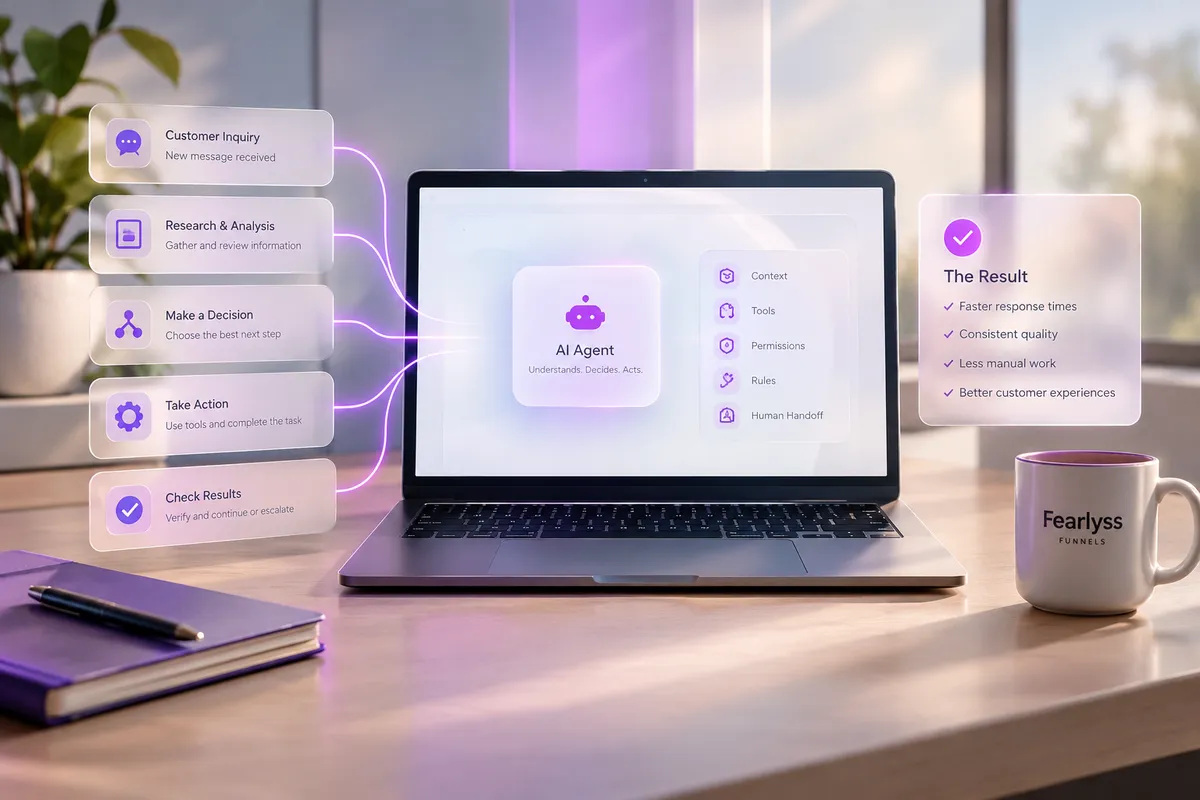
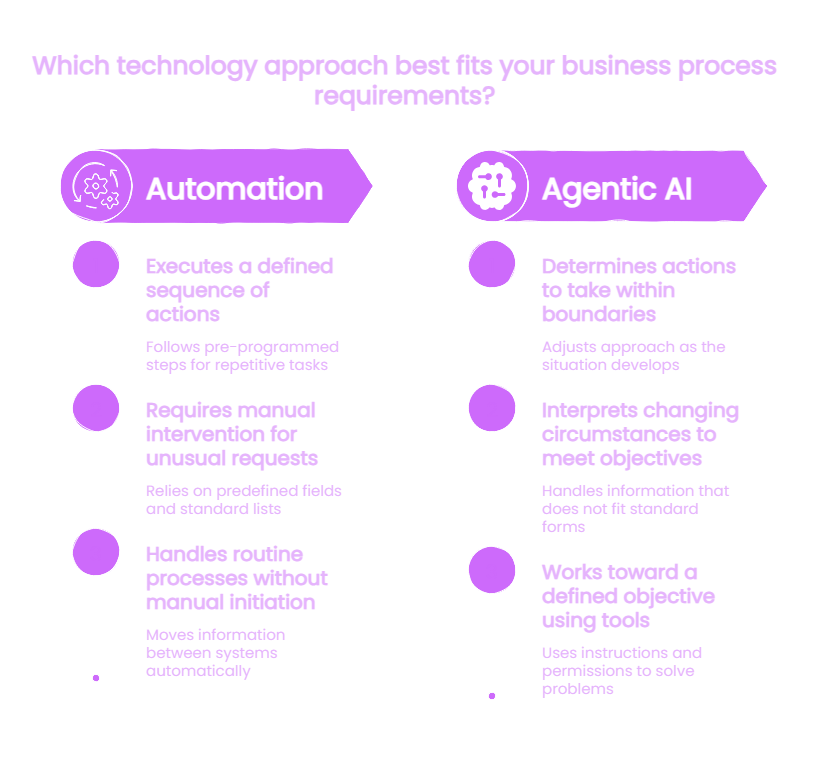
It is whether the work requires a defined sequence of actions, the ability to interpret changing circumstances, or some combination of both. Automation has already transformed how businesses handle repetitive work. It allows information to move between systems, messages to be delivered at the right time, and routine processes to continue without someone manually initiating every step. Agentic AI introduces another possibility. Depending on its design, tools, instructions, and permissions, an AI agent can work toward a defined objective, determine which actions to take within its assigned boundaries, use available tools, and adjust its approach as the situation develops. Understanding this difference matters because the two approaches serve different purposes. When you understand the nature of the work first, you can determine whether automation is sufficient, whether an AI agent may be useful, or whether a combination of technologies would better support the outcome your business needs.
Automation and Agentic AI Solve Different Parts of the Problem
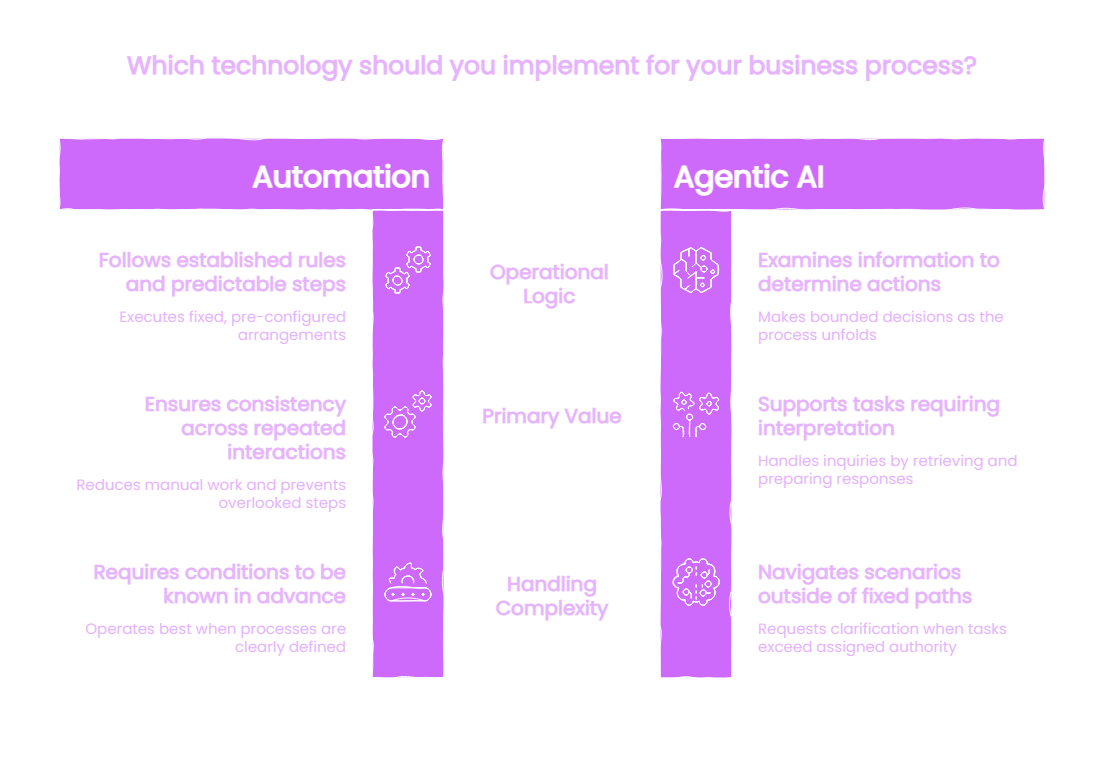
Automation is especially useful when a process can be described through established rules and predictable steps. When a customer books an appointment, for example, an automation can send a confirmation, update the contact record, notify the appropriate team member, and initiate a reminder sequence. Once the conditions and actions have been configured, the system follows that arrangement whenever the relevant trigger occurs. The value of automation comes from consistency. It allows a business to establish a process once and carry it out repeatedly. A well designed automation can reduce manual work, prevent routine steps from being overlooked, and help ensure that the same operational requirements are met across many customer interactions. This works particularly well when the conditions are known in advance. If a person fills out a form and selects a particular service, the system can assign the corresponding tag and send the appropriate follow up message.
The business has already determined what that selection means and what should happen because of it. The automation carries out the established decision. Agentic AI becomes relevant when the work requires more than following a predetermined sequence. An agent may receive a goal, examine the available information, select from permitted tools, and determine which action to take next based on what it encounters. Rather than relying exclusively on a single fixed path, it can make bounded decisions within the instructions and authority it has been given. Consider the customer inquiry again. An automation can send a standard response to every inquiry that meets a specified condition. An AI agent, if equipped with appropriate instructions and access to relevant information, might review the customer's question, identify the subject of the inquiry, retrieve an answer from approved business resources, and prepare a suitable response.
If the question falls outside its assigned authority, the agent can be instructed to request clarification or send the matter to a person. The difference is not simply that one technology is older and the other is more advanced. The difference lies in how the work is organized and how decisions are made during execution. Automation carries out a defined process. Agentic AI can support work that requires a degree of interpretation and decision making as the process unfolds. Both can be valuable, and neither automatically replaces the other. In many business environments, the most effective arrangement uses automation for predictable transitions and an AI agent for selected tasks that require interpretation.
What Changes When AI Can Participate in the Work?
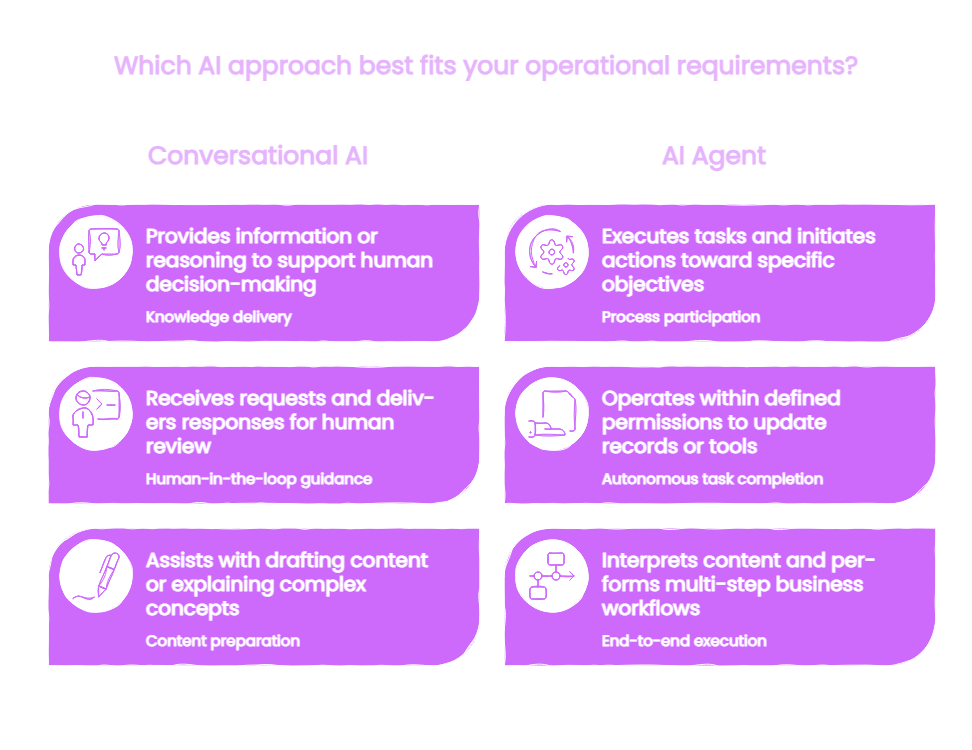
To understand the significance of agentic AI, it helps to distinguish between receiving an answer and participating in a process. A conversational AI assistant may help you write an email, explain a concept, or develop a plan. You provide the request, receive the response, and decide what to do with it. The AI contributes information or reasoning to your work, while you remain responsible for carrying the result into the relevant business environment.
An AI agent can be configured to participate more directly in an assigned process. Depending on the system, it may retrieve information, use connected tools, update permitted records, create a draft, or initiate an approved action. Its contribution can extend beyond generating a response because it has been configured to work toward an objective through a defined set of capabilities. Imagine that your business receives inquiries from several sources. You want each inquiry reviewed, classified according to your service offerings, and prepared for the appropriate next step.
A basic automation can route inquiries according to form selections, keywords, or other conditions that you have explicitly established. A conversational AI assistant can help you design those rules or develop the language used in your responses. An AI agent could potentially review the inquiry itself, interpret its content, compare it with approved service information, and recommend or initiate an appropriate next step. The actual actions available to it depend on the tools and permissions connected to the agent. If the agent is allowed to draft a response but not send it, its role ends at preparation. If it is authorized to update a CRM record, it may complete that action directly. If pricing exceptions or contractual commitments require human approval, the system should preserve that boundary. This is what makes agentic AI significant for business operations. It creates an opportunity to assign certain kinds of work to an AI system rather than using AI only as a source of information.
However, the opportunity becomes useful when the assigned work, the expected result, and the limits of the system are clearly established. The presence of an AI agent does not automatically mean that a process is intelligent, reliable, or well designed. An agent can be given a poorly defined objective, incomplete information, inappropriate access, or instructions that conflict with the way the business actually operates. It may then carry those weaknesses into its execution. The question, therefore, is not simply whether an agent can perform an action. It is whether the action belongs within the agent's assigned role, whether the necessary information is available, and whether the business has established the conditions under which the action should occur.
More Autonomy Requires More Deliberate Boundaries
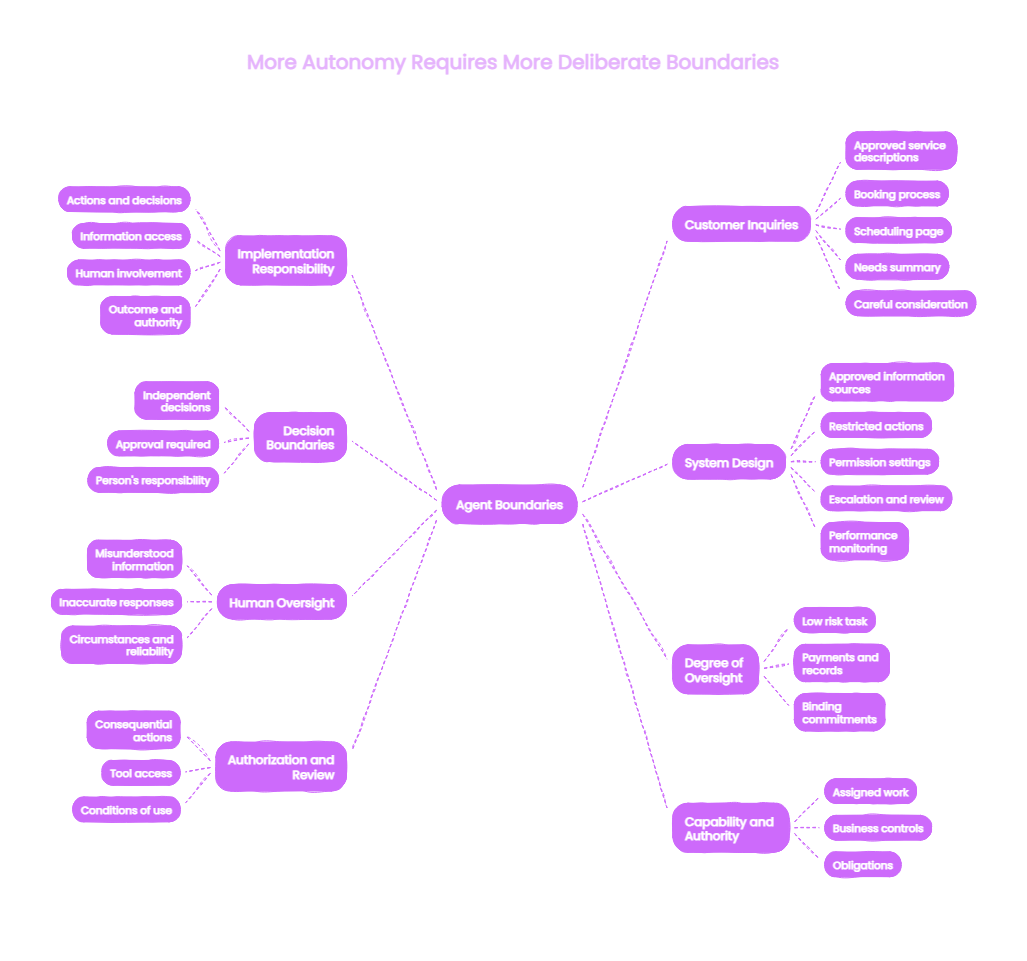
When a business automates a process, its rules and conditions determine what happens next. When a business introduces an AI agent, the design must account for the actions the agent can take, the decisions it may make, the information it can access, and the situations that require human involvement. This introduces a different kind of implementation responsibility. The business must establish not only the desired outcome but also the authority through which the system is permitted to pursue it. Consider an agent assigned to assist with customer inquiries. It may be appropriate for the agent to answer questions using approved service descriptions, explain the booking process, and direct customers to the correct scheduling page. It may also be appropriate for the agent to prepare a summary of a customer's needs for a team member. Other actions require more careful consideration. Offering a discount, changing a contract, making a promise about delivery, or disclosing confidential information can have consequences beyond the immediate interaction.
A business must determine which decisions the agent may make independently, which actions require approval, and which matters must remain with a person. These boundaries should be part of the system's design. They can include approved information sources, restricted actions, permission settings, escalation conditions, review requirements, and ways to monitor the agent's performance. They also need to reflect the actual responsibilities and commitments of the business. Human oversight remains important because AI systems can misunderstand information, produce inaccurate responses, or select an action that does not fit the circumstances. The appropriate degree of oversight depends on the work, the consequences of an error, and the reliability demonstrated in the actual operating environment. A low risk task, such as organizing incoming questions into broad categories for later review, may allow more flexibility than a task involving payments, confidential records, or binding commitments.
The more consequential the action, the more deliberate the authorization and review process should be. It is also important to understand that access to a tool does not establish that every use of that tool is appropriate. An agent may technically be able to update a record, send a message, or initiate a workflow. The business must still define when that action is warranted and what conditions govern its use. Good implementation brings capability and authority into alignment. The agent receives enough access to complete its assigned work, while the business retains the controls necessary to protect its customers, operations, and obligations.
Where Does an Agent Fit in a Real Business?
This distinction between automation and agentic AI becomes easier to apply when you examine the actual work happening inside your business. There is some work that is highly repetitive. Appointment reminders, internal notifications, routine data transfers, and follow up messages can often be handled through established automations. The expected action is known, the conditions can be defined, and the process generally follows a predictable path.
Other work requires interpretation. An incoming customer message may contain several questions, describe an unusual circumstance, or reveal that the customer needs something different from the service they initially selected. A team member may need to examine the information, determine what it means, and decide how the business should respond. An appropriately configured AI agent may be able to assist with part of that work. While other work depends on judgment that should remain with a person.
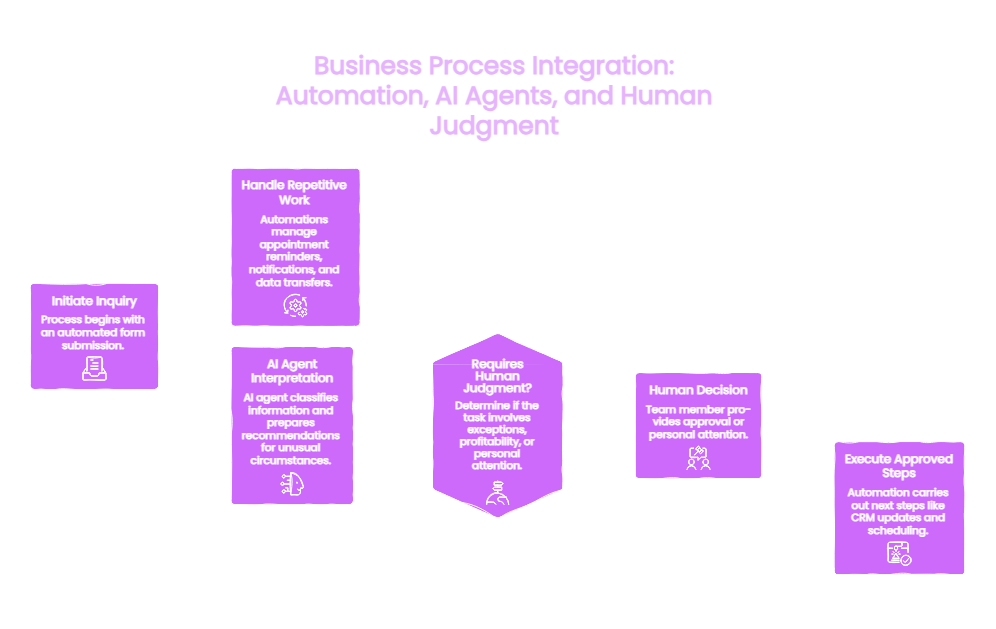
A customer may be asking for an exception that affects profitability, requesting a commitment the business has not approved, or raising a concern that requires personal attention. An agent can help gather the relevant information, organize the facts, or prepare a recommendation, while the decision remains with the person who holds the appropriate authority. These categories can coexist within one process. An inquiry may begin with an automated form submission, move to an AI agent for classification and preparation, and then reach a human team member for a decision. Once the person makes the decision, automation can carry out the approved next steps, such as sending the appropriate message, updating the CRM, and scheduling a follow up. In this arrangement, each component has a defined responsibility.
Automation handles predictable transitions. The AI agent supports interpretation and bounded execution. The human provides judgment, approval, or personal attention where the work requires it. This is often a more practical way to think about AI implementation than asking whether an entire business process should become automated or agentic. A process may contain several different kinds of work, and each kind may require a different approach. The goal is to establish a working arrangement in which the right capability supports the right part of the process. That requires understanding the process as it actually operates, including the exceptions, decisions, information requirements, and handoffs that determine whether the work reaches its intended result.
An Agent Can Expose What the Process Has Yet to Establish
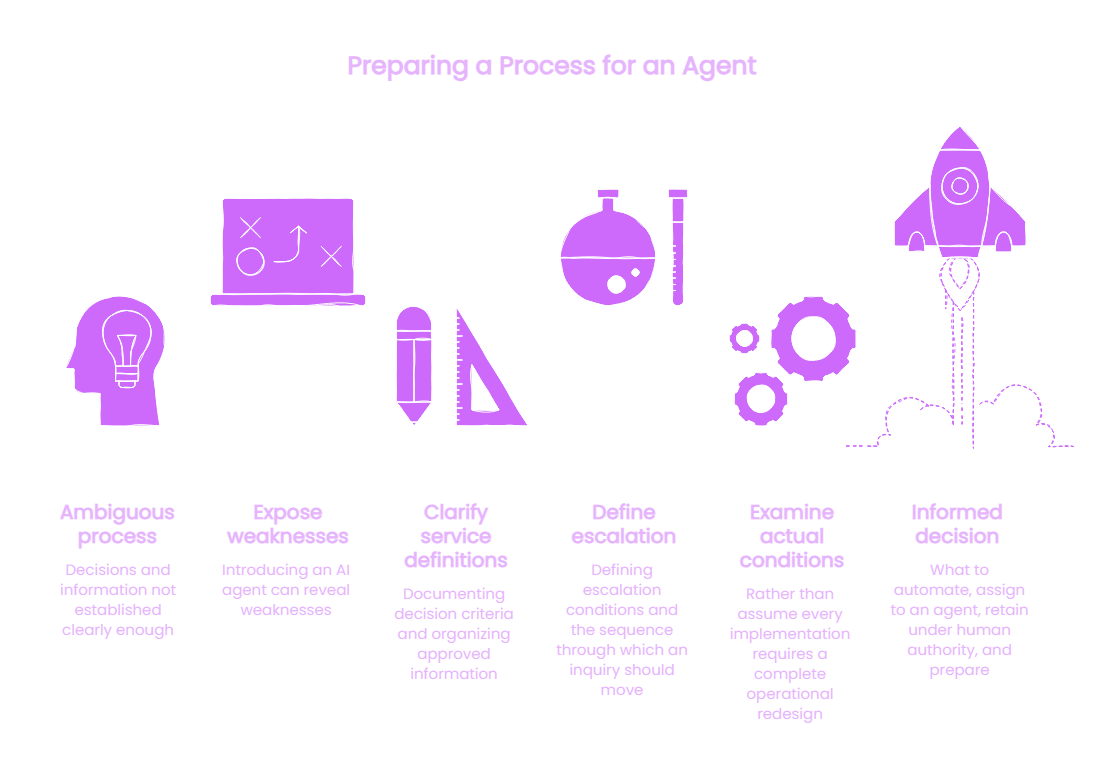
Introducing an AI agent can reveal weaknesses that were already present in a business process. Let’s say you want an agent to respond to questions about your services. During implementation, you discover that your service descriptions vary across your website and sales materials. Your pricing exceptions have never been documented. Your team uses different criteria to decide whether an inquiry is qualified, and no one has established what the agent should do when a customer's request falls between two service categories. Challenges may initially appear to be AI configuration problems. They point to decisions and information the business has yet to establish clearly enough for consistent execution. An agent needs an objective it can work toward, instructions that explain how the business expects the work to be performed, and access to information that supports its assigned responsibilities.
If the underlying process is ambiguous, the agent may produce an answer that sounds reasonable without accurately reflecting the business's actual practices. For example, telling an agent to recommend the best service for each customer leaves important questions unanswered. What makes a service the best fit? Which customer needs qualify for each offering? What limitations must be considered? When should the agent ask for more information? When should it stop and involve a person? The business needs to determine those matters before expecting the agent to handle them consistently. The implementation process may therefore involve clarifying service definitions, documenting decision criteria, organizing approved information, defining escalation conditions, and establishing the sequence through which an inquiry should move. This work is valuable even if the business ultimately decides that an agent is unnecessary.
A clearer process can improve staff training, customer communication, automation, and operational consistency regardless of which technology is used. It is also possible that the business already has a well defined process and only needs to connect the appropriate tools or configure the agent correctly. The important point is to examine the actual conditions rather than assume that every implementation requires a complete operational redesign. Agentic AI can be a useful addition to a business, but its usefulness depends on how well the assigned capability fits the work it is expected to perform. When the work is clearly understood, the business can make a more informed decision about what to automate, what to assign to an agent, what to retain under human authority, and what needs further preparation.
Identify the Work Before Choosing the Agent
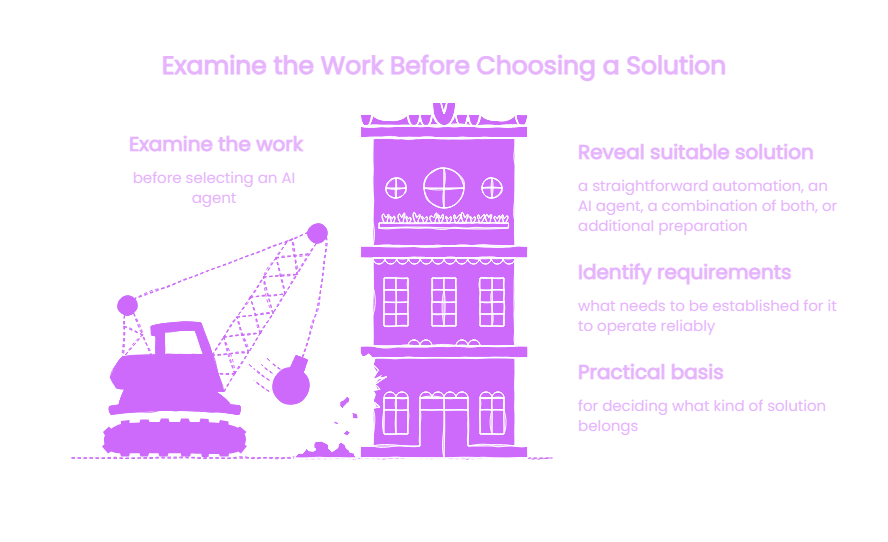
Before selecting an AI agent or investing in a new platform, take time to examine the work you want the system to perform. This gives you a practical basis for deciding what kind of solution belongs in your business and what needs to be established for it to operate reliably.
Start with one specific process rather than attempting to transform several areas of the business at once. Choose a task that consumes time, creates recurring friction, or requires repeated handling of similar information. An incoming customer inquiry, a client onboarding step, an internal reporting task, or the preparation of information for a team member can all provide a useful starting point. Describe what happens today. Identify how the process begins, what information enters it, which steps follow, where decisions are made, and what constitutes a successful outcome. Pay particular attention to the points where the process changes direction. These may include missing information, unusual requests, exceptions to standard procedures, or decisions that depend on human judgment.
Distinguish the predictable actions from the work that requires interpretation. If the same action should occur whenever a clearly defined condition is met, automation may be sufficient. If the task requires reviewing information and choosing among permitted actions based on the circumstances, an AI agent may be worth evaluating. If the decision carries significant consequences or requires authority that belongs to a person, identify that boundary before designing the system. Then examine the information and access the solution would require. An agent that answers service questions needs reliable service information. An agent that prepares a client record needs to know which fields matter and how the record should be organized. An agent expected to take action through another platform needs the appropriate connection and permissions. Each requirement should be established according to the actual work, rather than assumed because a particular tool advertises the capability.
Determine how you will know whether the solution is working. Define the expected result, test ordinary situations as well as exceptions, and decide what should happen when the system lacks sufficient information or encounters a request outside its authority. Establish who reviews the results, who handles escalations, and how the process will be adjusted when testing or operation reveals a problem.
Use the following questions to guide your examination.
1. What specific work needs to be completed?
Describe the task and the result the business needs. Focus on the work itself before naming a technology.
2. Which parts of the work follow predictable rules?
Identify the steps that can be triggered by established conditions and carried out consistently.
3. Which parts require interpretation or a decision?
Identify where the information varies, where the next step depends on the circumstances, and where an AI agent might provide useful support.
4. What must the system know and what may it do?
Determine the information, instructions, tools, and permissions required for the assigned task. Establish which actions are allowed and which require human approval.
5. What happens when the situation falls outside the expected conditions?
Define how the system should respond when information is missing, the request is unusual, or the appropriate next step cannot be determined confidently.
6. How will you evaluate the result?
Determine what successful execution looks like, how the process will be tested, and who is responsible for reviewing and improving it.
Your answers may reveal that a straightforward automation is the right solution. They may point toward an AI agent, a combination of both, or additional preparation before implementation can begin. Each outcome gives you useful information about the work and the conditions required to support it.
Choose the Work Before You Choose the Technology
Agentic AI expands the possibilities for how businesses can organize and execute work. It allows appropriately configured systems to participate in processes that involve interpretation, tool use, and decisions within established boundaries. Automation continues to provide value by carrying out predictable actions consistently. Together, these capabilities can support business operations in ways that neither approach necessarily accomplishes alone. So, the opportunity is to determine where each capability belongs. A business does not need an AI agent for every task, and introducing an agent does not automatically make a process more effective.
The value comes from matching the solution to the work, establishing the information and permissions it needs, and defining the conditions under which it can operate. This is why implementation should begin with the process you want to improve. When you understand the task, the decisions it requires, the boundaries it must respect, and the outcome it needs to produce, you have a stronger foundation for selecting and configuring the technology.
Before you choose the agent, understand the work you want it to do.
If you are exploring how AI, automation, and connected systems can support your business, the next step is to understand the work you want those capabilities to carry. Fearlyss Funnels offers learning resources, coaching, classes, through community.
Join Plug Club to help business owners develop their understanding of the tools and systems available to them. Continue learning about the practical application of technology in your business.